Independent Vintage Synth Sessions

Real Juno.
Real takes.
Real character.

Three original vintage synthesizers, recorded to order, for producers and artists who need the real thing. Not a plugin. Not a preset. Real hardware, played by hand.

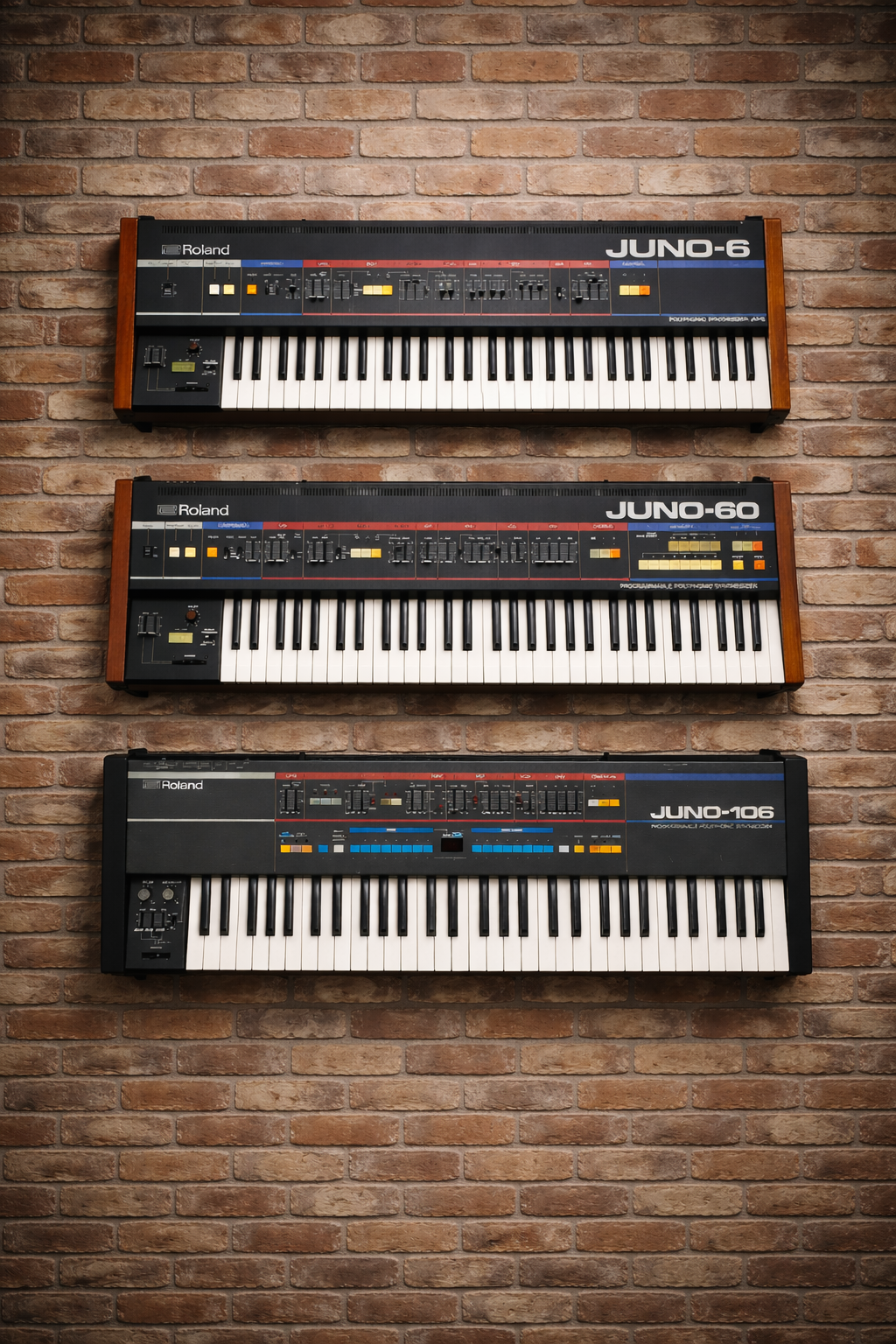
Juno-6 Juno-60 Juno-106
Juno synthesizer in studio

Some people own a Juno.
We have all three.

Think about what that means for a second. The Juno-6, the Juno-60, and the Juno-106: three distinct instruments, three distinct voices, three different chapters of one of the most beloved synthesizer lineages ever built. All original. All fully serviced. All in perfect working order. All available to you, wherever you are in the world, starting today.

How many studios can say that? How many producers have access to even one original Juno in genuinely great condition, not a restoration project, not a unit with failing chips or a degraded chorus, but a real, living, breathing instrument that performs exactly as it did the day it left the factory? We're talking about hardware that's over forty years old. Finding one is rare. Maintaining it properly is an obsession. Having all three is something else entirely.

The Juno Room exists so that obsession can work for your music. Send me your track from anywhere: Berlin, Tokyo, São Paulo, New York. I'll put real hands on real hardware and record takes that carry the weight, warmth, and unmistakable character that no plugin has ever fully captured. Because it can't. The physics don't transfer.

  • Three original instruments, zero compromise Juno-6, Juno-60, and Juno-106, fully serviced, perfectly tuned, ready to record
  • Performed, not programmed Every take played by hand on real hardware, feel and timing are part of the result
  • Available worldwide, delivered fast You send the idea. You receive the files. Location is irrelevant.

Something Ableton and plugins will never achieve.

Three instruments.
Infinite personalities.
One address.

Each Juno is a different conversation. A different mood, a different era, a different reason to choose analog over digital. The question isn't whether you want the real thing: it's which version of real speaks to your track.

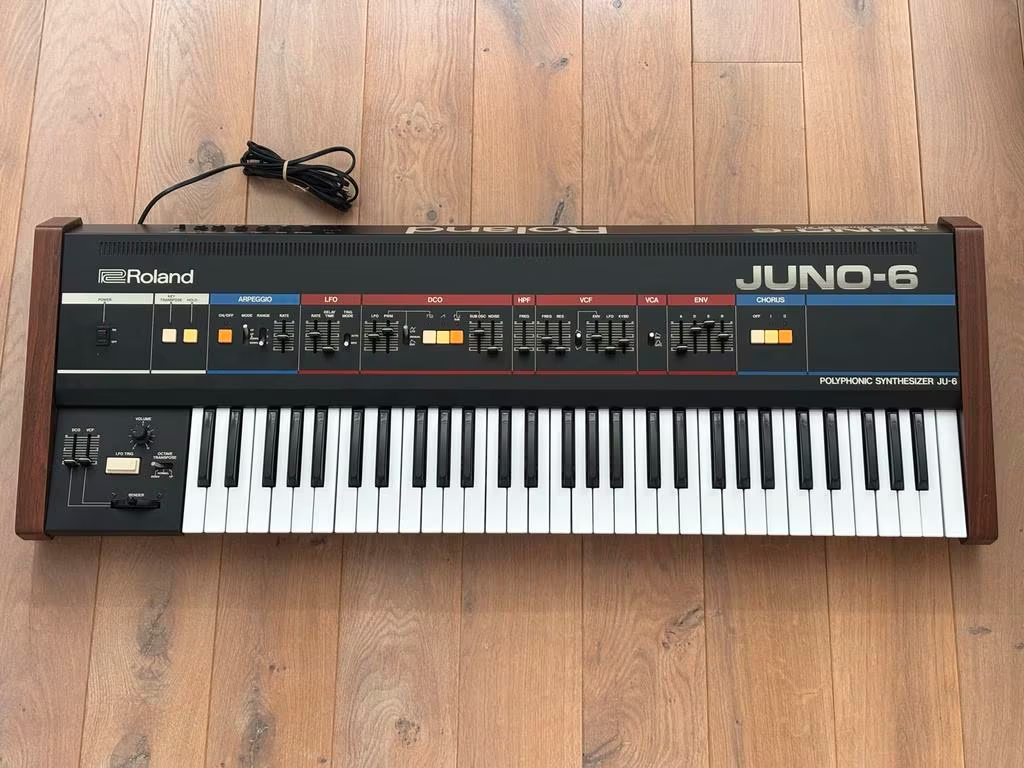
Roland Juno-6 synthesizer May 1982

Juno-6

The raw beginning.

The first of the line, and still the most unguarded. No patch memory, no layers of refinement, just a synthesizer that hadn't yet learned to hide anything. The Juno-6 plays with an openness that its successors smoothed away in the name of progress. Some things are lost in that smoothing.

Choose this one when your track needs something that feels lived-in rather than perfected. When you want the slightly rough edge that makes a chord feel human. The 6 doesn't flatter: it reveals. And sometimes that's exactly the difference between a good record and a great one.
Raw warmth Simple purity Early chorus
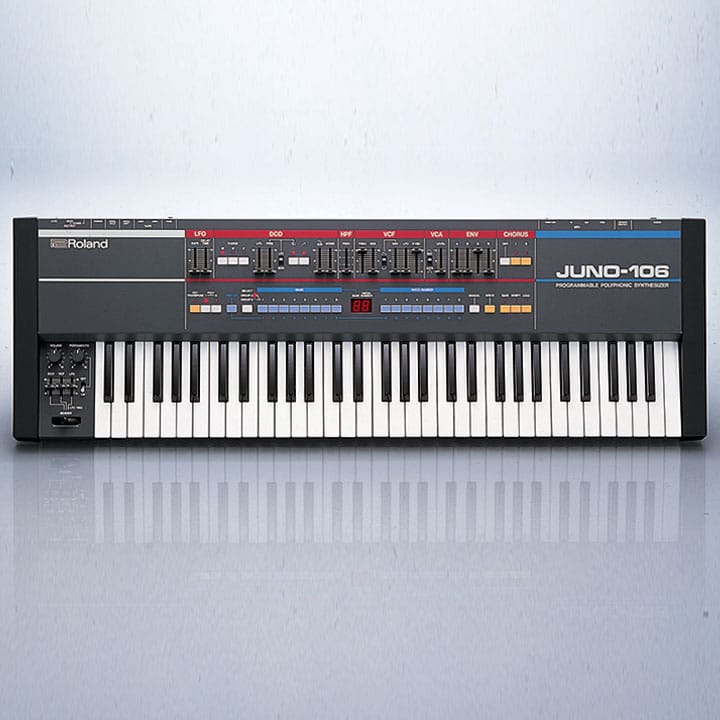
Roland Juno-106 synthesizer February 1984

Juno-106

The studio standard.

The most disciplined of the three, and the most immediately useful. MIDI, a cleaner voice architecture, a tighter low end: the 106 was built to work, and it has been working in professional studios for four decades without complaint. It doesn't demand attention. It just makes everything around it sound better.

Choose this one when you need vintage warmth that earns its place in a dense mix without fighting for it. Bass lines that bloom, pads that breathe without smearing, arpeggios with real punch. The 106 is the one session musicians reached for when the deadline was real and the sound needed to be right.
Studio clarity MIDI-ready Warm precision

Hear the difference.

Audio demos coming soon. Each instrument, recorded direct, no reverb, no effects. Just the pure voice of original hardware.

Juno-6 Pad, slow attack, Chorus I
Coming soon
Juno-60 Strings, full chorus, long release
Coming soon
Juno-106 Bass, DCO tight, chorus off
Coming soon

From your idea
to real Juno takes.

Simple, direct, personal. No intermediaries, no templates, no pre-recorded loop libraries. Just your track and a forty-year-old synthesizer that still has something to say.

  1. Send your idea

    A rough mix, a stem, a MIDI file, a voice note humming the melody, anything that gives me a window into your track. The more context, the better: mood, tempo, key, references. Don't worry about it being polished. This is the sketch phase.

  2. We choose the right Juno

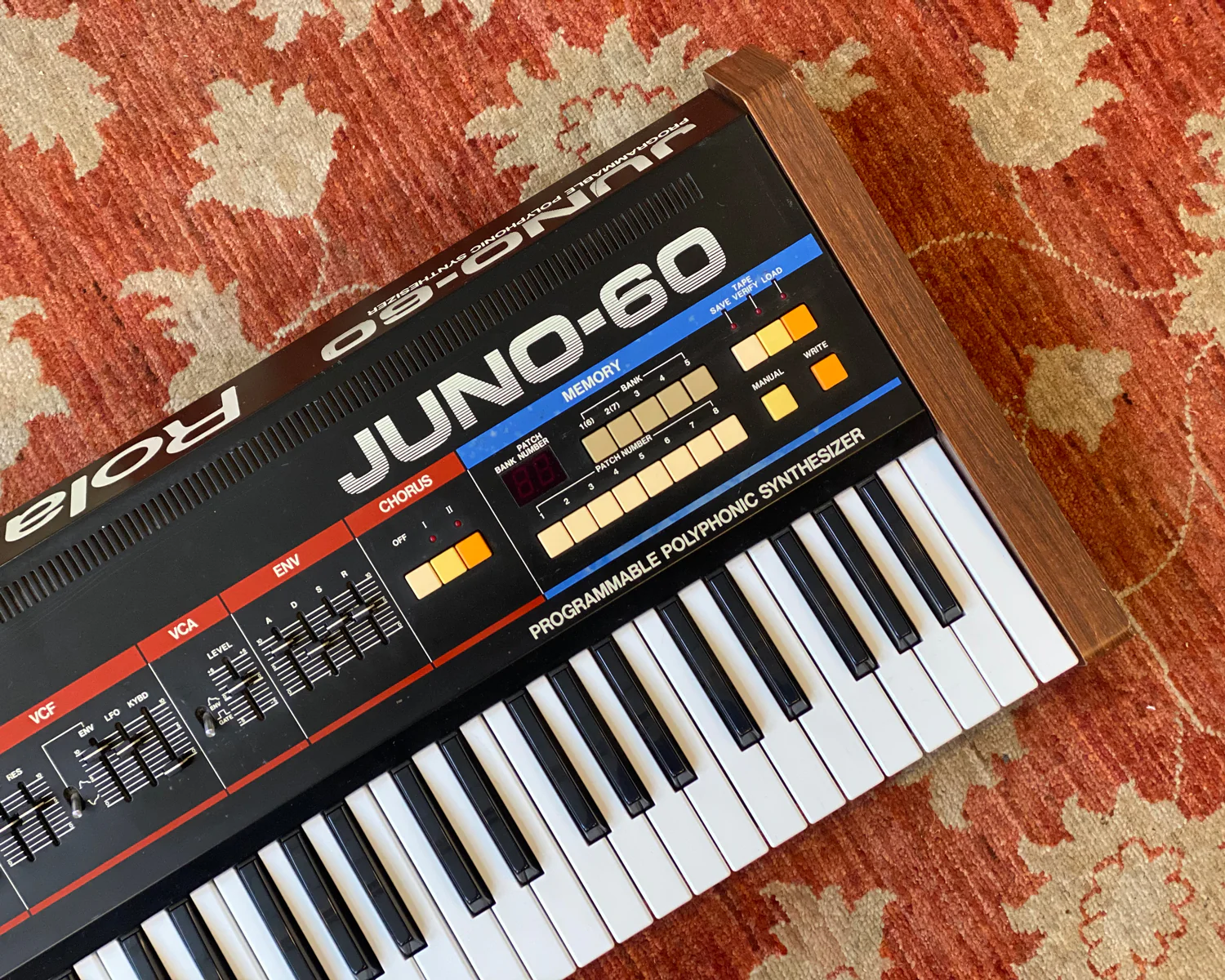
    Not every track needs the same instrument. The raw character of the 6, the romantic depth of the 60, the studio precision of the 106: each one pulls a different emotional register. I'll make a recommendation based on your material. You make the final call.

  3. I sit down and play

    Real hands on real keys. Original hardware, clean signal chain, multiple takes to give you options. Not a sample triggered by MIDI automation: an actual performance, with the feel and subtle variation that only happens when a human being plays an instrument in real time.

  4. The files land in your DAW

    High-resolution WAV, private download link, everything labeled. You choose what fits, discard what doesn't. If the first round isn't exactly right, we go again. The session ends when your track has what it needs. Not before.

What you receive

  • Multiple takes per part
  • 24-bit / 48kHz WAV (higher on request)
  • Dry signal and processed versions
  • Patch notes and settings documentation
  • Optional video proof of the recording
  • Typically 48–72 hour turnaround

Forty years later,
nothing sounds like this.

The software industry has spent decades trying to recreate what these instruments do. Thousands of developers, millions of lines of code, endless modeling algorithms. And yet: when you play a real Juno, you know immediately that something is different. Something that can't be quantified in a spec sheet.

In 1982, Roland set out to build an affordable polyphonic synthesizer. What they actually built was a cultural artifact. The DCO architecture kept the sound stable without killing the organic feel. The onboard chorus, designed as a practical solution to a technical limitation, turned out to be one of the most beautiful accidents in the history of electronic music. The filter breathed. The whole instrument felt alive in a way that its price tag had no business promising.

The Juno didn't just appear on records. It became part of the emotional vocabulary of an era: the shimmer in the pads, the warmth in the chord stabs, the wide luminous quality that made even simple parts feel like they were reaching for something. Synth-pop, new wave, post-punk, the birth of house music, the Juno was there, doing the quiet work that holds a song together. Forty years later, producers still describe a feeling and then say: "something like a Juno."

Juno-6 released

Six-voice DCO polyphony. No patch memory. Pure analog immediacy. The beginning of a lineage.

Juno-60 released

Patch memory added. Refined voice. DCB connectivity. The version that would become the cult classic.

Juno-106 released

MIDI integration. Cleaner voice architecture. A fixture in professional studios throughout the decade and beyond.

Still in active use

Sought after by producers, collectors, and artists who understand that certain tools can't be replicated, only preserved.

Ask a producer what they'd want in their studio if money were no object. Somewhere in that conversation, a Juno comes up. Ask them which one: you'll start a debate that lasts until the early hours. The instrument's fingerprint is all over the records that matter, across genres, across decades, across every boundary that music pretends to have.

Synth-pop & New Wave

The wide, shimmering pads. The arpeggios climbing toward something unnameable. The Juno gave synth-pop its emotional core: a warmth that stopped the electronics from feeling cold, a luminosity that made even simple chord progressions feel important.

Electronic & House

The 106's bass lines and chord stabs helped build the foundation of early house music. That sustained pad underneath a four-four kick, the one that makes a dance floor feel like a cathedral, often had a Juno at its origin.

Modern Indie & Dream-pop

Forty years on, artists still describe a feeling and then say: "something like a Juno." Indie, lo-fi, ambient, dream-pop, the instrument keeps appearing because the gap between what plugins promise and what hardware delivers is still audible to anyone who's listening carefully.

Your track deserves
the real thing.

You already know the difference. That's why you're here. There's a part on your track, maybe you can hear it already, maybe it's still a feeling, that needs the weight of a real instrument behind it. Not a simulation. Not a carefully modeled approximation. The actual hardware, played by a human being, in real time.

This service exists for artists who refuse to settle for "close enough." Whether you're finishing a major label record or recording in your bedroom at 2am: if you care about the sound, we should talk.

Useful things to include

  • A rough mix or stem, even unfinished
  • Tempo and key information
  • A reference track or mood description
  • MIDI if you have it (optional, not required)
  • Which Juno you're drawn to, or leave it open

No commitment required. I'll respond within 24 hours.